
Overview
"Refactor virus" is not an official Ingress item name — it is a search phrase that blends two real items: ADA Refactor and JARVIS Virus. Both are "flip cards," items that instantly convert a portal's faction control rather than requiring a slow attack-and-rebuild process. If you saw the phrase somewhere and want to know what it actually refers to, the short answer is that you are looking for one (or both) of these two items, and the faction they push a portal toward depends on which one you use.
This article works through that terminology confusion first, then moves into the mechanics that actually matter when you are holding one of these items: which faction each one targets, what it costs in XM, what happens to resonators, links, and control fields, whether you earn AP, and when the trade-off is worth it. Because ADA Refactor and JARVIS Virus share nearly identical mechanics and differ mainly in direction, a side-by-side comparison and a worked cost example are the fastest way to get oriented before you use — or save — a rare flip card.
Terminology: one phrase, two items
The phrase reads like a single item, but it is really two items with a shared design. Understanding that split now will save you from misapplying rules that belong to only one of them.
Is "refactor virus" an official item name?
No visible evidence supports "refactor virus" as an official in-scanner item label. The items referenced by that phrase are ADA Refactor and JARVIS Virus, each documented separately under their own names on reference sources such as the Ingress Wiki's ADA Refactor entry and the Ingress Shop's JARVIS Virus page. Early community coverage, including a 2013 Ingress Report segment, referred to "the Jarvis virus" and "the Adar Refactor" as informal shorthand for the same pair of items, which likely explains why the combined, slightly garbled phrase persists in search behavior. It's also worth separating this from the unrelated, much older use of "refactor" in software engineering — a term meaning a structural code change that preserves behavior, as Kyle Shevlin's essay on the word explains by way of Martin Fowler's definition. That meaning has nothing to do with Ingress; this article stays with the game context.
Why ADA Refactor and JARVIS Virus are searched together
They're searched together because they are functionally the same tool aimed in opposite directions. Fev Games' flip card reference describes them as a matched pair: "the ADA Refactor flips an Enlightened portal to Resistance control, while the JARVIS Virus does the opposite" (Fev Games). Both are classified as very rare, both cost XM scaled to portal level, and both skip the usual resonator-by-resonator takedown. A player who encounters one item naturally runs into the other in the same breath, which is why guides and forum threads tend to mention them as a set rather than in isolation.
ADA Refactor vs JARVIS Virus
Because the two items are mirror images of each other, the clearest way to compare them is side by side. The table below consolidates the target faction, resulting faction, ownership behavior, and cost basis drawn from the Ingress Shop and Fev Games references.
| Attribute | ADA Refactor | JARVIS Virus |
|---|---|---|
| Item type | Flip card (Very Rare) | Flip card (Very Rare) |
| Valid target | Enlightened-controlled portal | Resistance-controlled portal |
| Resulting faction | Resistance | Enlightened |
| XM cost | 1,000 XM × portal level | 1,000 XM × portal level |
| AP awarded | None, including for broken links | None, including for broken links |
| Ownership if flipped to your own faction | Transfers to your agent account | Transfers to your agent account |
| Ownership if flipped away from your faction | Transfers to the ADA non-player account | Transfers to the JARVIS non-player account |
| Effect on Machina portals | Neutralizes instead of flipping | Neutralizes instead of flipping |
| Recycle value | Not specified in cited sources | 100 XM |
Sources: ADA Refactor — Ingress Wiki, JARVIS Virus — Ingress Shop, Flip Card — Fev Games.
The simplest difference
The core distinction is direction: ADA Refactor only works on Enlightened portals and pushes them to Resistance, while JARVIS Virus only works on Resistance portals and pushes them to Enlightened. Consider a concrete case. A Resistance agent finds a fully-built Level 4 Enlightened portal feeding two links into a mid-size control field, and they have 5,000 XM on hand plus one ADA Refactor. Using the item costs 1,000 XM per portal level — so 4,000 XM for this Level 4 target (Ingress Wiki; Fev Games). Note this 1,000-XM-per-level figure is the usage cost of the item, not an XM storage capacity — an agent's XM capacity scales with their own access level, not with the portal's level. The portal flips instantly to Resistance, ownership (with its resonators and mods) transfers to the agent because the result matches their own faction, and both links break in the process. After spending 4,000 XM the agent has roughly 1,000 XM left and a portal now under Resistance control — but the flip does not register as a portal capture on the agent's own stats, and it awards zero AP for either the flip or the broken links. The item trades resources for territory, not score.
Which item should you use?
Which item applies is determined entirely by the current faction of the target portal, not by preference:
- If the portal is Enlightened and you want it Resistance, ADA Refactor is the only flip card that applies.
- If the portal is Resistance and you want it Enlightened, JARVIS Virus is the only flip card that applies.
- If the portal is already neutral, neither item works — flip cards cannot be used on neutral portals, per Fev Games.
- If the portal is Machina, either item neutralizes it instead of flipping it to a player faction.
Checking the portal's current faction before opening your inventory avoids wasting the wrong item on an ineligible target.
How flip cards work
Both items follow the same sequence of state changes, so it helps to walk through it as a single before-during-after process rather than a list of disconnected facts.
Before use: check the portal and your resources
Before committing a rare item, confirm the basics that determine whether the action will even succeed:
- The portal's current faction matches the item you're holding (Enlightened for ADA Refactor, Resistance for JARVIS Virus).
- The portal is not neutral, since flip cards cannot convert a neutral portal.
- You have enough XM on hand — the cost is 1,000 XM per portal level, so a Level 8 portal requires 8,000 XM (Fev Games; community guide).
- The portal has not been flipped by the same item type within the past hour, since a repeat attempt inside that window can fail and waste the item, per the same community reference.
If any of these checks fail, using the item is either impossible or a wasted attempt, so it's worth confirming all four before committing.
During use: the portal changes faction
Once conditions are met, the conversion is immediate: the portal's faction flips to the item's target faction in a single action, with no gradual resonator drain or attack sequence involved. This is the defining feature that separates flip cards from ordinary attacking — a portal that might otherwise take a coordinated team an extended session to neutralize and recapture changes ownership in one step.
After use: links, fields, AP, and immunity matter
The consequences after the flip are where players most often get surprised. All links attached to the portal break at the moment of conversion, per the Ingress Shop reference, which means any control field relying on that portal collapses along with them. No AP is awarded for the flip itself or for the links it destroys — the same source is explicit that "the Agent does not get any AP," a rule echoed in the community technical breakdown. Finally, the portal picks up a temporary immunity window; an official Ingress announcement from November 2013 states that "portals now have a temporary 1 hour immunity to ADA Refactor and JARVIS Virus weapons after a Refactor or Virus has been deployed," so the same portal cannot be flipped again by either item until that hour passes.
Costs and consequences players should calculate
Because flip cards bypass the usual attack economy, their real cost isn't just the XM spent — it's the combination of XM, lost AP opportunity, and collateral damage to links and fields. Weighing all three before using a rare item is what separates a good flip from a wasted one.
XM cost examples
The rate is consistent across both items: 1,000 XM per portal level. A Level 1 portal costs 1,000 XM to flip, while a Level 8 portal costs 8,000 XM — a meaningful chunk of most agents' XM capacity, especially since XM also fuels travel and other actions. If you or a team track flip-card spend across several portals — XM paid, resulting faction, and whether a link or field was lost — a plain log is usually enough to keep the numbers straight. A tool such as TablePage lets you upload that log as a CSV, TSV, XLSX, or XLS file and get a shareable, filterable dataset page without signing up, which can make it easier for a cluster to compare notes on which flips were actually worth the XM.
No AP can change the value of the move
Because neither item awards AP — not for the conversion, not for the links it breaks — a flip card is a pure control tool, not a scoring tool. An agent chasing AP targets is better served by a conventional attack-and-link cycle, since the AP from destroying enemy resonators, links, and fields adds up in ways that flip cards deliberately bypass. Recognizing this up front prevents disappointment: the payoff for using ADA Refactor or JARVIS Virus is territorial, not statistical.
Link and field damage can be the point or the problem
Breaking every link on the flipped portal can be exactly what you want if that portal anchors a field you're trying to remove, or a nuisance link cutting through your team's territory. It becomes a problem when the portal you're flipping also anchors your own team's field or links — flipping it to "your side" doesn't rebuild those connections, since Ingress link and field mechanics require you to re-establish them manually after ownership changes. Before using a flip card, it's worth asking whether the structure being destroyed is enemy infrastructure you want gone, or friendly infrastructure you'll have to rebuild.
The economics of flip cards: a data view
Rather than treating the cost rules as isolated trivia, it helps to lay the published figures out as a dataset and read the pattern. Every number below is sourced from the Ingress Wiki flip-card entry (Fandom; ingress.wiki.gg), the item pages for ADA Refactor and JARVIS Virus, and cross-checked against Fev Games and a 3rd-faction strategy write-up.
Usage cost by portal level
The usage cost is strictly linear — 1,000 XM per portal level — so the full curve is fixed and known. Expressing each cost as a multiple of the item's own 100 XM recycle value shows how quickly the spend outgrows the salvage-it-instead option:
| Portal level | XM cost to flip | Cost ÷ recycle value (100 XM) |
|---|---|---|
| L1 | 1,000 | 10× |
| L2 | 2,000 | 20× |
| L3 | 3,000 | 30× |
| L4 | 4,000 | 40× |
| L5 | 5,000 | 50× |
| L6 | 6,000 | 60× |
| L7 | 7,000 | 70× |
| L8 | 8,000 | 80× |
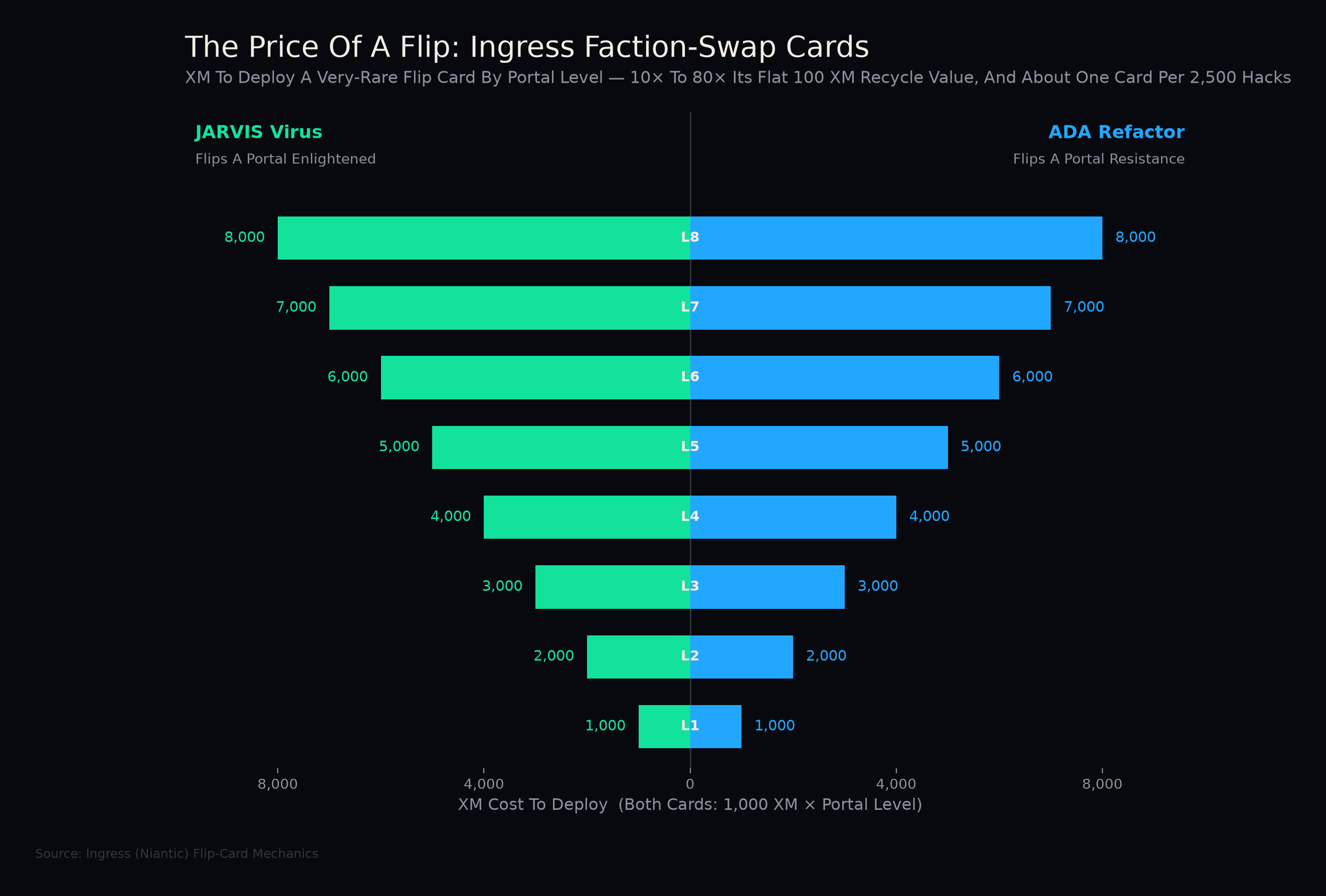
Sources for the cost formula and the 100 XM recycle value: Ingress Wiki — Flip Card, ingress.wiki.gg. The takeaway is that at L8 the item costs the equivalent of recycling eighty flip cards' worth of XM, which is why high-level flips are treated as premium plays rather than routine ones.
Acquisition cost: how rare "very rare" actually is
The scarcity side of the ledger is what makes the XM cost secondary for most agents. Community drop-rate studies cited by the wiki put the flip-card drop at 1 in 2,500 hacking rolls, independent of agent or portal faction (Ingress Wiki; ingress.wiki.gg). Read as an expected value, that means an agent hacking a single portal repeatedly should expect roughly one flip card every 2,500 hacks. A player hacking 100 portals a day would average about one flip card every 25 days of steady play — before accounting for hack cooldowns and burnout limits. That acquisition curve, not the XM price, is why guides frame these items as "save it for the right target."
Reading the whole cost picture
Putting the three published constants together — a linear 1,000 XM/level usage cost, a fixed 100 XM recycle value, and a ~1-in-2,500 drop rate — the real cost of a flip is dominated by scarcity, not XM. The XM outlay tops out at 8,000; the acquisition cost is an expected 2,500 hacks. Layer on the two rules that carry no number but reshape the value — zero AP awarded and a 60-minute post-use immunity window (Ingress Wiki) — and the dataset explains the community consensus: flip cards are scarce, XM-cheap relative to their rarity, score-neutral, and single-shot per portal per hour.
A compact table like the one above is exactly the kind of reference a local team keeps and updates. If you want to track your own flip-card ledger — level flipped, XM spent, resulting faction, AP forgone — alongside the published baselines, you can upload that log as a CSV, TSV, or XLSX file to TablePage and get a shareable, filterable dataset page without signing up, which makes it easy for a cluster to compare their real usage against the reference figures here.
Rules, restrictions, and edge cases
A handful of edge cases determine whether a flip card will work at all, and missing them is the most common way to waste a very rare item.
Recently flipped portals and immunity
A portal that was flipped within the last hour is temporarily protected from the same treatment. The official Ingress announcement establishing this rule states the immunity lasts one hour after a Refactor or Virus is deployed, and a community technical reference adds that attempting to use the same item type again within that window can cause the action to fail outright and consume the item anyway. If you're coordinating with teammates, checking whether someone else already flipped the target recently is worth the extra step before you spend your own copy.
Neutral portals and Machina portals
Flip cards are built to convert portals between the two player factions, not to claim contested ground from scratch. Per Fev Games, they cannot be used on neutral portals at all, and they also cannot be used on a portal already aligned with the faction the card would produce — there's no "wasted" use on a portal that's already the target color. Machina portals behave differently still: using either ADA Refactor or JARVIS Virus on a Machina-controlled portal neutralizes it instead of handing it to a player faction, which matters if you were hoping to claim it outright.
Same-faction and opposite-faction ownership outcomes
Ownership after a flip depends on whether the outcome matches the faction of the agent who used the item. If the conversion produces the same faction as the user — for example, an Enlightened agent using JARVIS Virus on a Resistance portal — ownership, resonators, and mods transfer directly to that agent, per the Ingress Shop. If the conversion instead pushes the portal to the opposite faction of the user — such as a Resistance agent using JARVIS Virus on their own team's portal — ownership goes to a special non-player account, JARVIS or ADA depending on the item, as described on both the Ingress Wiki and Fev Games. This matters tactically: a portal owned by a non-player account isn't "yours" the way a normally captured portal is, even though it now displays the faction you wanted.
When using a flip card is worth it
Given the XM cost, the lack of AP, and the risk of breaking friendly structure, a flip card is worth using only in specific situations rather than as a default tool. The two lists below separate the cases where spending one makes sense from the cases where holding onto it is the smarter move.
Good reasons to use one
Because these items convert a portal instantly and bypass the usual attack sequence, they're strongest when speed or certainty matters more than AP:
- Capturing a strategically critical portal — an anchor for a large field, a key link node, or an event target — faster than a coordinated attack would allow.
- Removing a difficult enemy anchor portal that would otherwise take an extended session to neutralize and re-link.
- Cutting an inconvenient enemy link or field quickly, when the collateral link destruction works in your favor.
- Acting alone on a target that would normally require a team, since the flip doesn't depend on sustained resonator damage.
- Converting a Machina portal out of Machina control when neutralizing it serves your team's broader plan.
Reasons to save it
Given the scarcity of very rare items and the lack of AP reward, there are just as many situations where waiting or attacking conventionally is the better call:
- The XM cost is high relative to your current reserves, and spending it would leave you vulnerable elsewhere.
- The target portal anchors your own team's links or fields, meaning the flip would demolish structure you'd have to rebuild.
- A standard attack-and-capture would work just as well without spending a very rare item.
- The portal was flipped by the same item type within the last hour, meaning your attempt could fail and waste the card.
- You're saving the item for a higher-value target, an anomaly, or a coordinated team operation where its instant-conversion effect matters more.
Lore and naming context
The two special non-player accounts, ADA and JARVIS, aren't arbitrary labels — they tie back to Ingress's in-fiction characters. A 2013 Ingress Report segment described the items as being named "the Jarvis virus, named after Roland Jarvis, and the ADA refactor, named after the sensient computer program created by the Niantic project" (Ingress Report coverage). That framing explains why a flipped portal that lands on the "wrong side" for the user gets assigned to an account bearing one of those names rather than to the player directly. Lore is a nice-to-know here, not something that changes how the items function, so it's worth treating as background color rather than a mechanic to plan around.
Questions players often ask
The questions below cover the practical points that come up most often once a player understands the basic terminology and comparison.
Do you get AP for using ADA Refactor or JARVIS Virus?
No. The Ingress Shop reference is explicit that using either item awards no AP, and that this includes AP that would normally come from breaking the portal's links. This is the main reason to think of flip cards as strategic-control tools rather than scoring moves — if your goal is AP, a conventional attack sequence will serve you better.
Can you use a flip card on any portal?
No. Each item only works on a portal currently held by the opposing faction it targets — ADA Refactor needs an Enlightened portal, JARVIS Virus needs a Resistance one — and neither works on a neutral portal, per Fev Games. Machina portals respond differently, getting neutralized rather than flipped to a player faction, and a portal that was flipped by the same item type within the past hour is temporarily immune.
What should you verify before using a rare flip card?
Because these items are very rare and non-refundable once spent, a short verification pass before use is worth the extra thirty seconds. If your local team keeps a running log of flip-card usage and outcomes, publishing it as a shareable, filterable page — for example by uploading a spreadsheet through TablePage — lets teammates check past results before spending another one. Before you commit, confirm:
- The portal's current faction matches your item (Enlightened for ADA Refactor, Resistance for JARVIS Virus).
- The portal isn't neutral and isn't already aligned with your target faction.
- You have enough XM banked — 1,000 XM per portal level, so plan for the full amount at higher levels.
- The portal hasn't been flipped by the same item type in the last hour.
- You've accepted that no AP will come from the flip or the resulting broken links.
- The links and fields that will break are ones you actually want gone, not your own team's structure.
- The specific rule you're relying on — especially the immunity window and cost figures — still matches current in-scanner behavior, since some of these mechanics were documented in older community and shop references rather than a single live source.